
SEO in 2026: How to Win Rankings in the Age of AI Overviews & Generative Search
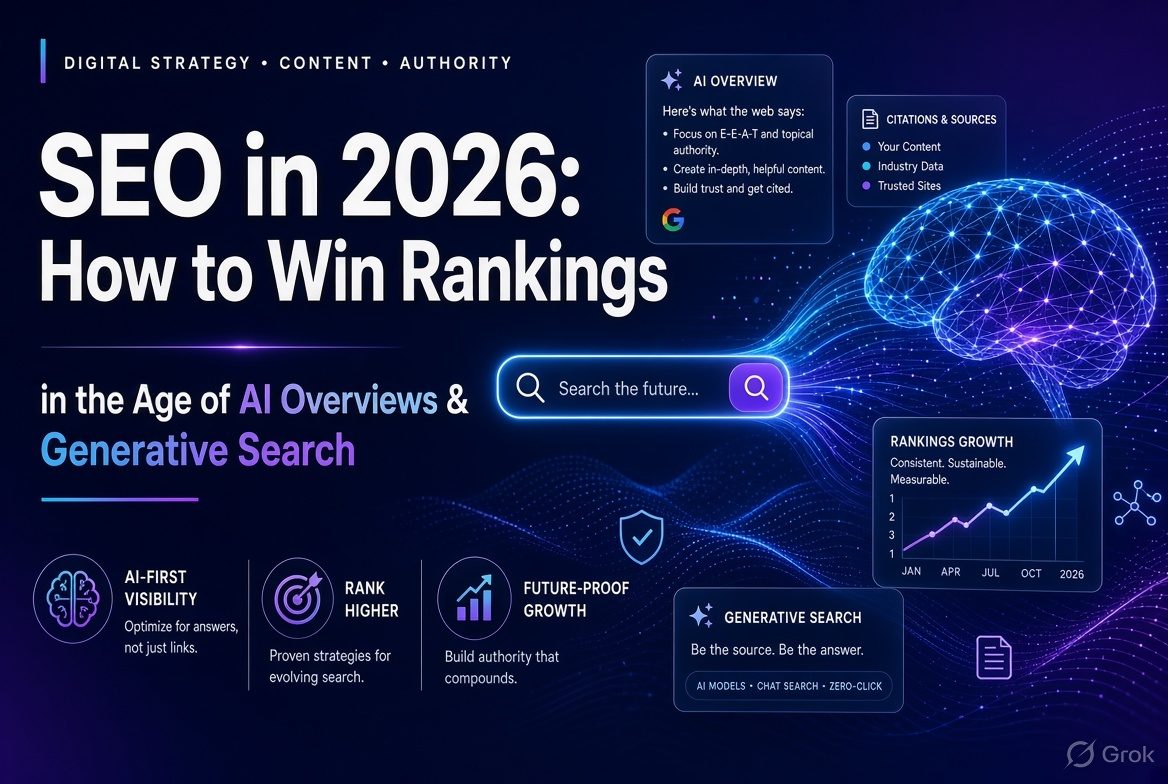
If your SEO strategy still focuses mainly on keywords, backlinks, and blue-link rankings, you’re already behind. In 2026, search has fundamentally changed. Google’s AI Overviews appear on a huge portion of queries, zero-click searches now exceed 68%, and users increasingly get answers from ChatGPT, Perplexity, and other generative engines before they ever visit a website.
The winners this year aren’t just ranking — they’re being cited, trusted, and remembered. Here’s the practical SEO framework that actually works in 2026.
1. Shift from SEO to GEO (Generative Engine Optimization)
Traditional SEO gets you ranked. GEO gets you cited by AI systems. When ChatGPT, Google AI Overviews, or Perplexity answer a question, they pull from sources they consider authoritative and clear.
- Lead with the answer — Put the clear, direct answer in the first 100–150 words.
- Use structured, scannable formatting — Short paragraphs, clear headings, bullet points, and tables make extraction easier.
- Build topical authority — Cover the full cluster of related questions instead of isolated keywords.
- Add original data or experience — AI systems heavily favor unique insights over generic summaries.
2. Double Down on E-E-A-T (Especially Experience & Entities)
Google’s E-E-A-T framework has evolved. Experience and entity recognition now carry more weight than ever. Pages that show real-world expertise and clear brand/entity signals outperform pure content volume.
Practical moves: showcase author credentials, publish first-hand case studies, maintain consistent brand mentions across the web, and strengthen your Knowledge Graph presence.
3. Optimize for Zero-Click & AI Visibility
Ranking #1 no longer guarantees traffic. Many users get their answer directly from the AI Overview. Your goal expands beyond clicks to brand visibility and trust signals inside the answer itself.
- Create content that is quotable and factually dense.
- Target “micro-intents” — the specific sub-questions people ask after the main query.
- Monitor AI impressions in Google Search Console’s generative AI performance report.
4. Technical Foundations Still Matter
Core Web Vitals, mobile performance, clean architecture, and proper indexing remain non-negotiable. AI systems still rely on the same underlying retrieval systems as traditional search. A slow or poorly structured site loses both rankings and AI citations.
5. Quality Over Quantity — Always
Google has made it clear: scaled, low-value AI content is a major spam target in 2026. Publishing fewer, higher-effort pages that demonstrate genuine expertise will outperform mass content production every time.
Key Takeaway for 2026
The best SEO strategy today combines classic technical excellence with content that is uniquely useful, experience-backed, and easy for both humans and AI systems to understand and cite. Rankings still matter — but visibility inside AI answers is the new competitive edge.
Start by auditing your top pages for answer-first structure, original insights, and clear entity signals. The sites that adapt fastest in 2026 will own the visibility that others are still chasing through outdated tactics.